

A Promising Idea, But Can It Separate Signal from the Noise
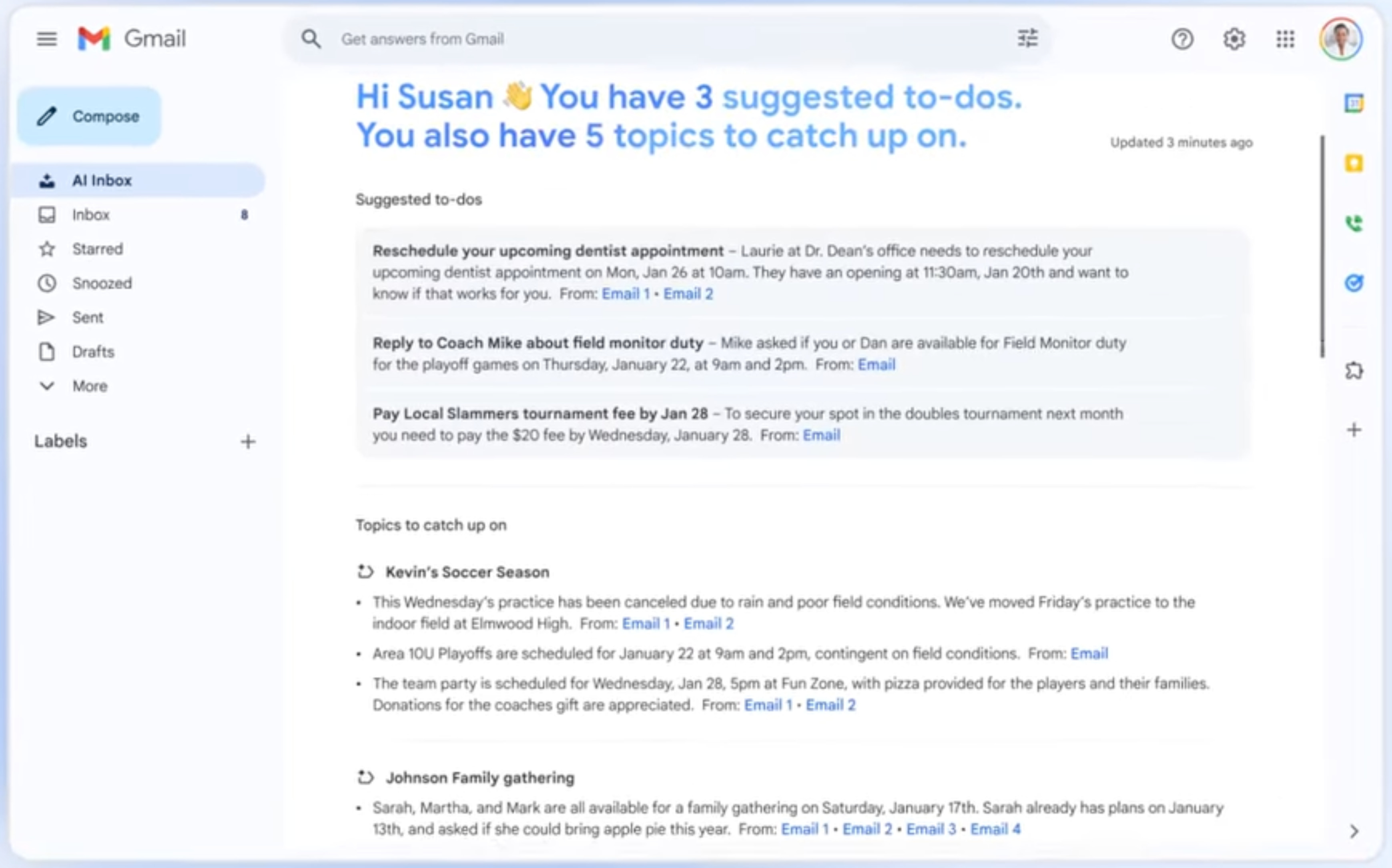
Google just announced that, in 2026, it plans to transform how most of us engage with our inboxes by adding a new AI Inbox view that surfaces our most critical emails and summarizes the rest.
Most of us dread email, so I’m open to almost any serious attempt to make it more manageable. AI has already, and will continue to, make email better for many people.
And while I have some skepticism about Gmail’s current implementation of AI Inbox, at least based on the announcement, I do think it’s pointing in a promising direction.
That said, I do have a few nitpicks with what Google demoed.
First, Gmail isn’t the first product to offer a summary layer over the inbox. It’s clearly building on ideas that Cora explored earlier. I never used Cora myself, but I was excited by what they were attempting. This kind of summary layer will be useful, so I’m glad Gmail, and likely others, are taking a serious stab at it.
Second, this doesn’t solve the deeper attention and focus problems I’ve written about elsewhere. A smarter inbox may reduce friction, but it doesn’t change the underlying dynamics of distraction.
Third, and most concerning. is the set of signals AI Inbox appears to use to determine what’s important. According to Google’s press release, AI Inbox works by:
identifying your VIPs based on signals like people you email frequently, those in your contacts list and relationships it can infer from message content. This lets high-stakes items — like a bill due tomorrow or a dentist reminder — rise to the top.
This is not how I would choose to rank my most critical emails.
As I’ve argued, email is primarily a place where other people tell you what’s important to them. An “urgent” client email is not always truly urgent; nor should it always be presented to you as such.
As an agency owner, I’d want an AI summary to prioritize emails from potential new clients: people I’ve never, or rarely, corresponded with before. I would not want it to elevate messages from the client who emails at all hours of the night with manufactured emergencies.
So I hope there’s a way to explicitly prompt AI Inbox toward what’s truly important to me. Without that, it risks encouraging the worst behavior from the loudest actors, the ones most determined to dominate our inboxes.
Finally, as a longtime Superhuman user, I’m most curious to see how they might approach a summary layer of their own, and whether they’ll give users more control over what “important” actually means.