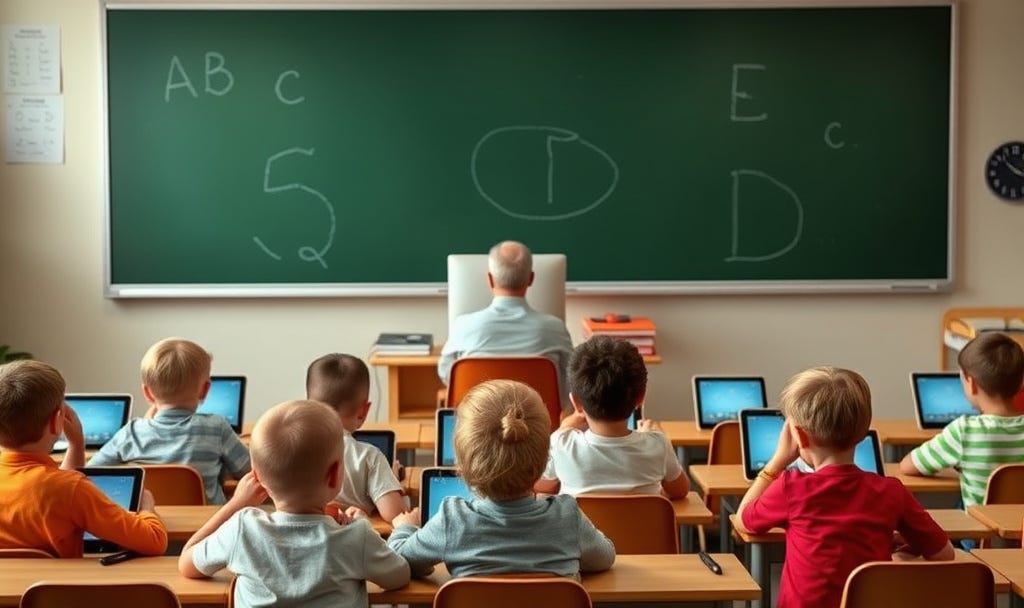
A group of local parents recently launched an initiative to change how much screen time our children have during the school day. It’s part survey, part manifesto, and it’s encouraging parents to raise our voices against screen time in our schools.
My thinking on screens and kids has always been twofold. One, computers and the internet have long been a fact of our world, and we must train our children to be proficient users of these tools.
However, screens, and in particular social media, have countless insidious effects on young people, a dystopian list that includes cyberbullying, sexual assault, and unregulated access to drugs, many tragically laced with deadly compounds.
If this local initiative had been launched two years ago, or even one year ago, I would have raised my hand in unwavering support.
But this manifesto didn’t arrive a year ago. It arrived this week. And this week, looking at its recommendations, I find myself unsure how to respond.
While I believe the manifesto is well-intentioned, and agree with many points raised, including:
Computers and iPads are often being used to fill free time or indoor recess, with minimal supervision. This limits opportunities for socialization, hands on learning, and creativity.
And;
Students are allowed access to YouTube. Inappropriate content slips through filters on this platform has prompted partial or entire bans in other school districts.
There are parts of the manifesto that give me pause, namely:
At the elementary school level, preset settings in Google Classroom offer autocorrect for spelling and autocomplete for sentences, undermining students’ learning of both spelling and writing composition.
And;
Math homework can only be completed using online software.
What, broadly and specifically, gives me pause about such a manifesto/survey?
One, it’s hard not to look at any survey about kids’ screen usage and not see that the adults around the kids are equally addicted and reliant on their screens.
The behavior we’re modeling for our kids is that of heavy screen dependence, if not co-dependence. Our kids look at us as adults and see us on our phones. I’d wager most of our kids see us with a phone in our hands more than without.
So hypocrisy runs deep when it comes to screen time.
It reminds me of campaigns against texting and driving aimed at teenage drivers. When I walk around my suburban neighborhood or commute into the city, it’s the adult drivers who seem most likely to be using their phones while driving.
We like to think of screen time addiction as a problem with younger generations, without standing back to look at our own behaviors and how those behaviors get passed down to the very kids and teenagers we’re trying to protect.
I’m all for any movement to reduce our collective screen time, but adults have to be willing to put down their phones as well. And frankly, I’m not sure the adults are.
Second, my feelings about spell check and autocorrect for young kids are mixed. On the one hand, I can see how, absent these tools, children must first learn to spell on their own accord before letting the tools correct their mistakes.
However, the tools will be there for them soon enough. Even as an adult, I lean on tools like spell check, Grammarly, and AI (more on this in a moment) to check my writing.
Will keeping them from using spell check for a few more months because it’s toggled off by default, really stop what’s coming?
Speaking of what’s coming, and this is really where I’m entirely conflicted about almost everything I wrote above.
What is happening on our screens, right now in early 2026, thanks to artificial intelligence, is altering the world in ways we have yet to understand and won’t be able to fully process until we’re looking in the rearview mirror.
In a recent essay, Dario Amodei suggests that AI will soon outperform humans at most cognitive tasks:
We are now at the point where AI models are beginning to make progress in solving unsolved mathematical problems, and are good enough at coding that some of the strongest engineers I’ve ever met are now handing over almost all their coding to AI. Three years ago, AI struggled with elementary school arithmetic problems and was barely capable of writing a single line of code. Similar rates of improvement are occurring across biological science, finance, physics, and a variety of agentic tasks. If the exponential continues—which is not certain, but now has a decade-long track record supporting it—then it cannot possibly be more than a few years before AI is better than humans at essentially everything.
How will this affect our kids and change the opportunities that are available to them?
Amodei is predicting that AI will “displace half of all entry-level white collar jobs in the next 1–5 years,” and worries that, while the labor market may reset itself in the face of AI, just as the labor market has done after previous technology shifts, “the short-term shock will be unprecedented in size.”
Short-term shock… meaning likely during the labor market our own children will face in a few years’ time.
When my first child was born, I recall thinking that, to give him a leg up, I should immerse him in Mandarin classes and coding lessons.
That was five years ago. Will either skill be necessary in the next five years?
I’d like to believe that social skills, getting along with one’s peers, and having a basic understanding of grammar and math will be necessary skills for humans in the short term, or at least within my kids’ lifetimes.
And yet, I can no longer fathom what skills my now elementary school-aged kids will need by the time they enter the job market.
Will they need to be proficient in AI prompting? Will prompting still be a thing? Or will the labor market be seeking young people who can focus for more than a few minutes at a time and who have developed social skills and the ability to cooperate?
I don’t think this survey was misguided. It raises valid points that I can get behind. But given everything that’s happening around us right now, I’m not sure spell check is the problem.
While we’re debating how much screen time our kids should have, the rules on the ground are changing faster than we can make sense of them.
What do you think about kids’ use of screens at school? Is AI re-shaping your opinion on screen time? Let me know in the comments below.